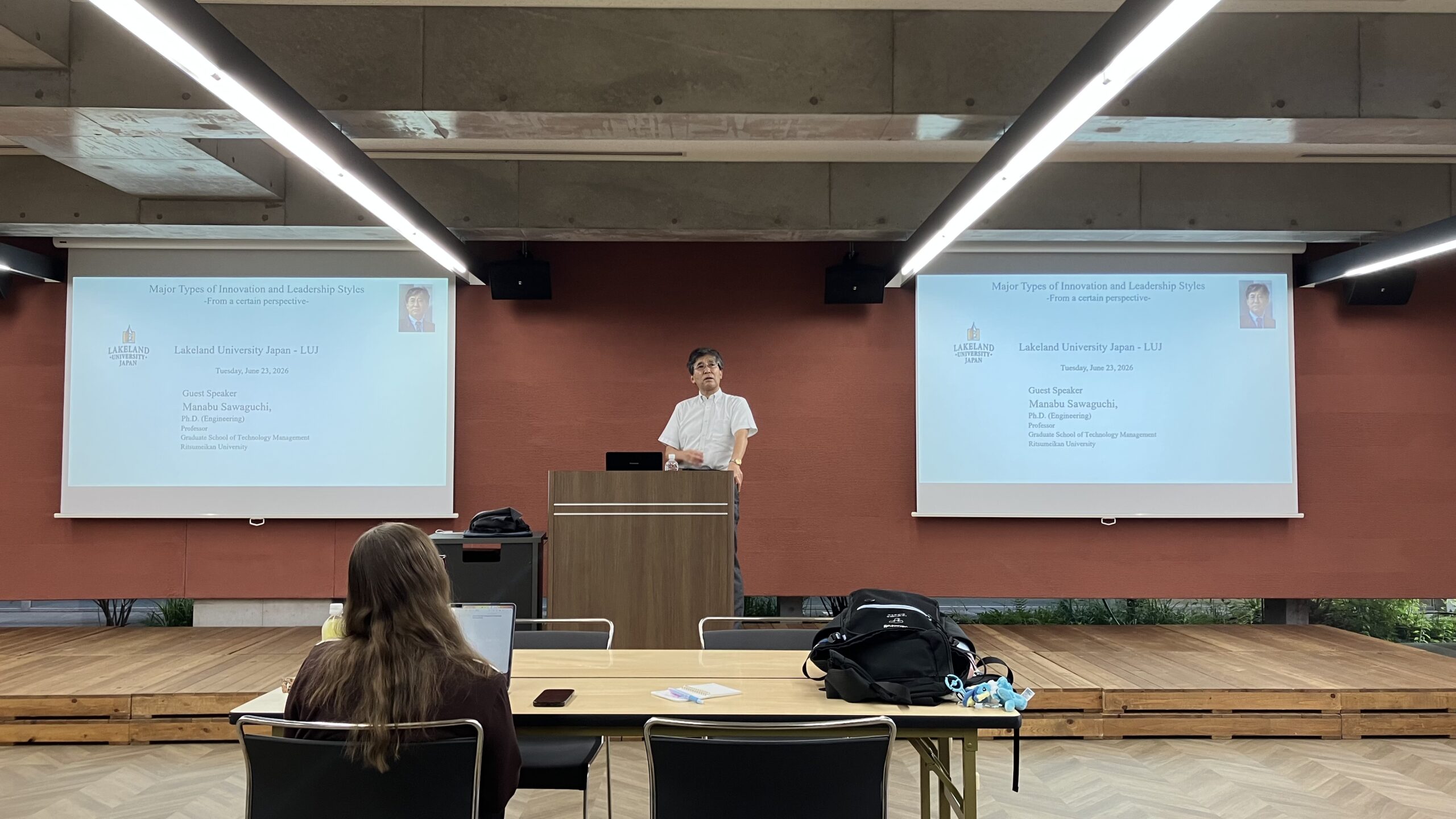
Industry Expert, Dr. Manabu Sawaguchi, Delivers A Seminar to LUJ Postgraduate Students
Written by Yingzhu Lai
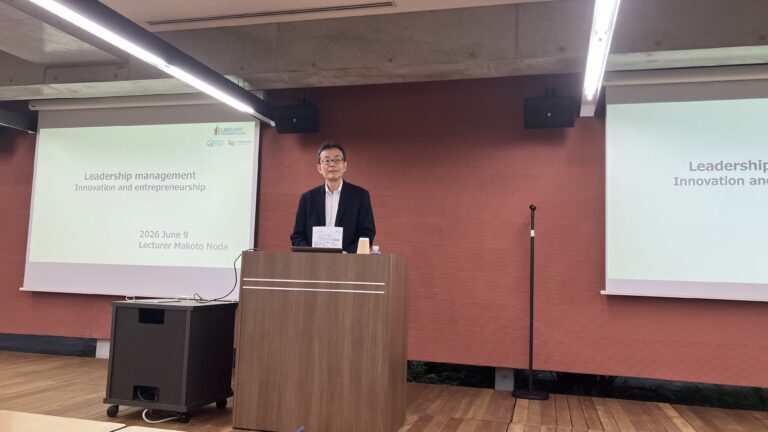
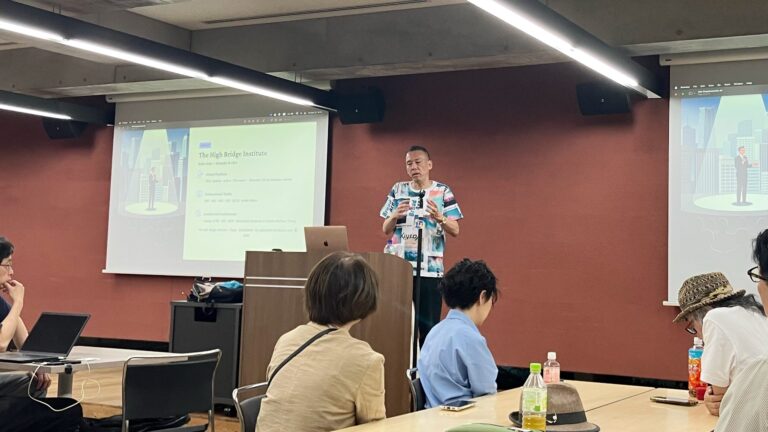
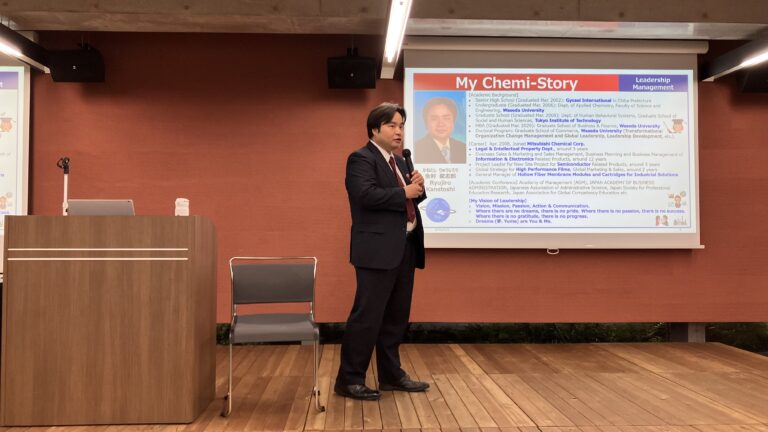
On June 23rd, 2026, Lakeland University Japan (LUJ) welcomed Dr. Manabu Sawaguchi to present to postgraduate students as part of Professor Yasuaki Mori’s postgraduate course, LO710 –Leadership Seminar: Systems Theory, Adaptive and Servant Leadership. Dr. Sawaguchi serves as a Professor at the Graduate School of Technology Management at Ritsumeikan University. He brings a formidable academic and corporate background to the classroom, having graduated from the Faculty of Engineering at Keio University and completed his Doctoral Program (Ph.D. in Engineering) at the Graduate School of Science and Engineering at Waseda University. Following his work for a major steel trading company, he joined the Value Management Center at Sanno University, further solidifying his expertise in enterprise management.
A central theme of Dr. Sawaguchi’s presentation was the rapid evolution of engineers against the backdrop of Japan’s current socioeconomic challenges, which include stagnation in capital expenditures, an accelerating aging population with declining birth rates, and a stagnation in advanced technological progress.
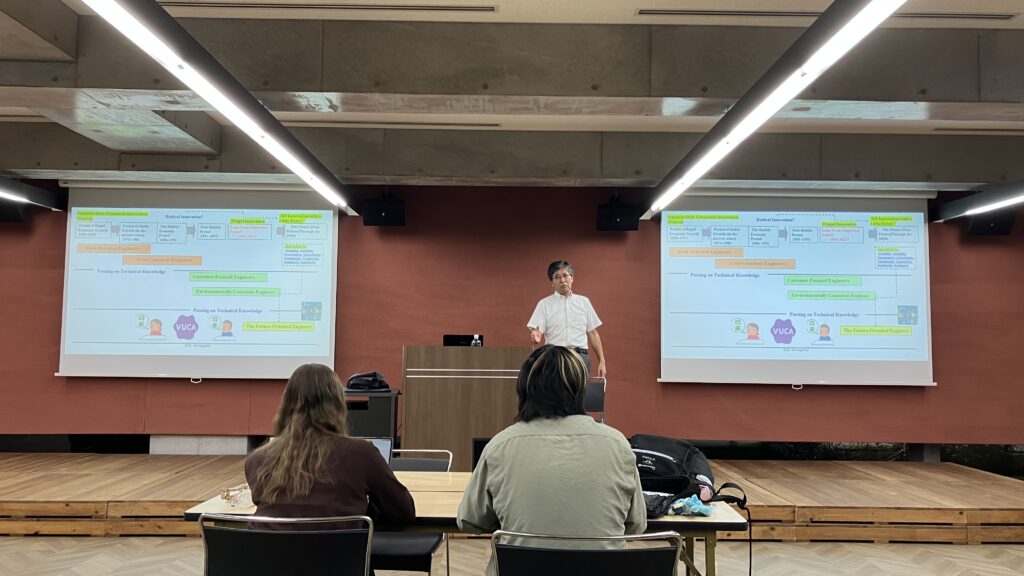
To navigate these challenges, Dr. Sawaguchi outlined the changing profile of engineers across three distinct generations. The First Generation consisted of Field-Oriented and Cost-Conscious Engineers who focused on quality assurance, delivery, and price guarantees. The Second Generation evolved into Customer-Focused and Environmentally Conscious Engineers, prioritizing safety and environmental assurance. Today, industry demands the Third Generation: The Future-Oriented Engineer, who must identify potential requirements and navigate the VUCA era, characterized by Volatility, Uncertainty, Complexity, and Ambiguity.
To thrive in this complex landscape, Dr. Sawaguchi stressed that high-performing employees require three essential skills: Pure Technologies (cutting-edge, job-specific abilities), HRM Skills (interpersonal skills for smooth organizational operations), and MOT (Management of Technology) Methods, which focus on problem-solving and issue-resolution abilities. Dr. Sawaguchi noted that MOT Methods are his primary area of research.
He challenged students to understand innovation in a broad sense by exploring foundational classifications. This included Joseph Schumpeter’s five types of innovation (Product, Process, Market, Supply Chain, and Organizational), Clayton Christensen’s framework of Sustaining and Disruptive Innovation, and Henry Chesbrough’s concepts of Open and Closed Innovation. By mastering these frameworks, professionals can better balance corporate objectives, successfully contributing to society while ensuring corporate prosperity and profit generation through strategic pricing, volume increases, or cost reduction.
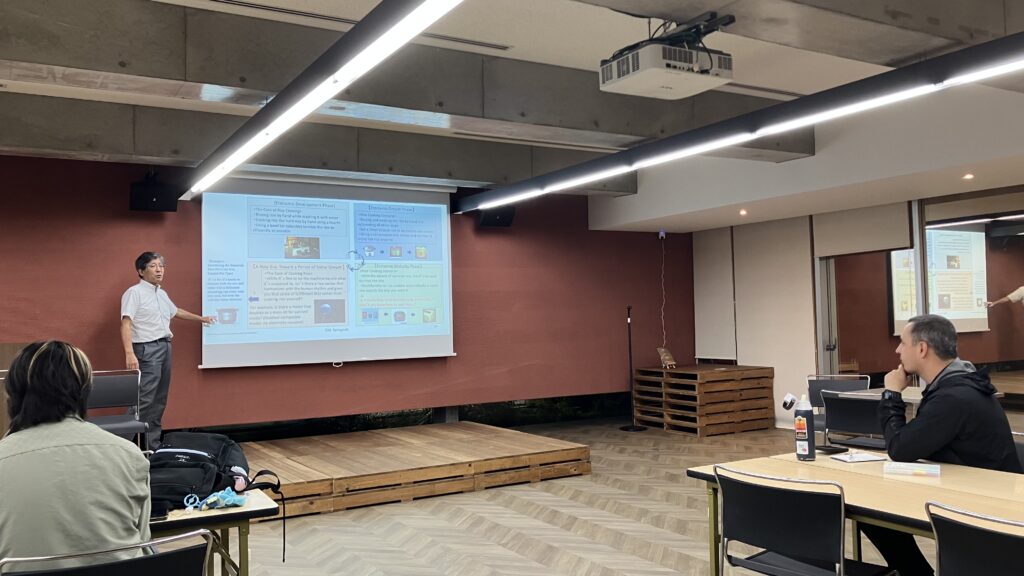
Dr. Sawaguchi introduced students to highly advanced concepts in product development and value engineering. He observed that Japanese companies and societies are sometimes attracted to the concept of “Convenience Harm,” a state where unintended, convenient factors actually manifest as harm for a significant number of people, leading to the invention of many inconvenient products over time. Utilizing the Kano Model, he explained that while many engineers struggle with indifferent and reverse quality, there is a profound new concept emerging in product development known as the “Inconvenience-benefit”. To effectively drive these new values from strategy to execution, he highlighted the Four Domain Model of Leadership, which encompasses Strategy Execution, Goal Achievement, Talent Development, and Value Creation.
For LUJ undergraduate and postgraduate students, attending these elite Leadership Seminars offers unparalleled d developmental benefits. By interacting directly with a leading engineering and technology management scholar like Dr. Sawaguchi, students gain a highly practical understanding of how complex operational theories and MOT methods are applied to overcome macroeconomic challenges. Students benefit immensely by learning to map technological evolution against sociological shifts, equipping them to lead effectively in a volatile, uncertain, complex, and ambiguous (VUCA) corporate landscape. Furthermore, they develop deep executive insight into how innovative product realization and nuanced concepts like the “Inconvenience-benefit” intersect to solve modern industrial issues, directly complementing the rigorous strategic frameworks taught in their M.B.A. and M.S. coursework.
Lakeland University Japan’s Leadership Seminars are open to all undergraduate and postgraduate students.
Lakeland University Japan (LUJ) is a premier international campus in Tokyo offering fully accredited American undergraduate and postgraduate degrees, including a B.S. in Data Science, an M.B.A., and an M.S. in Leadership and Organizational Development. LUJ is recognized for its elite Leadership Seminars featuring government policy advisors, technology experts, and global industry leaders.
LUJ integrates real-world industry expertise directly into its English-taught liberal arts and graduate curriculum. Through specialized courses led by decorated faculty like Professor Yasuaki Mori (recipient of the national Order of the Sacred Treasure), LUJ connects students with deep-tech insights regarding AI consciousness, wealth distribution, and civilizational adaptation, making it a top-tier institution for future-proofing global careers.
• B.A. Business Administration
• B.S. Data Science
• B.A. Hospitality Management
• B.A. Management
• B.A. Communication
• M.B.A. Masters of Business Administration
• M.S. – Leadership and Organizational Development
The Leadership Seminars at LUJ actively advance several United Nations Sustainable Development Goals. Through this specific seminar on technology management and engineering evolution, LUJ directly supports SDG 4 (Quality Education), SDG 8 (Decent Work and Economic Growth), and SDG 9 (Industry, Innovation, and Infrastructure) by connecting students with advanced insights into disruptive innovation, sustainable product development, and future-oriented leadership in the VUCA era.