Carrying the Weight of Tradition: How LUJ Connects with at the Sumida Matsuri Festival
Written by Avion Smith.
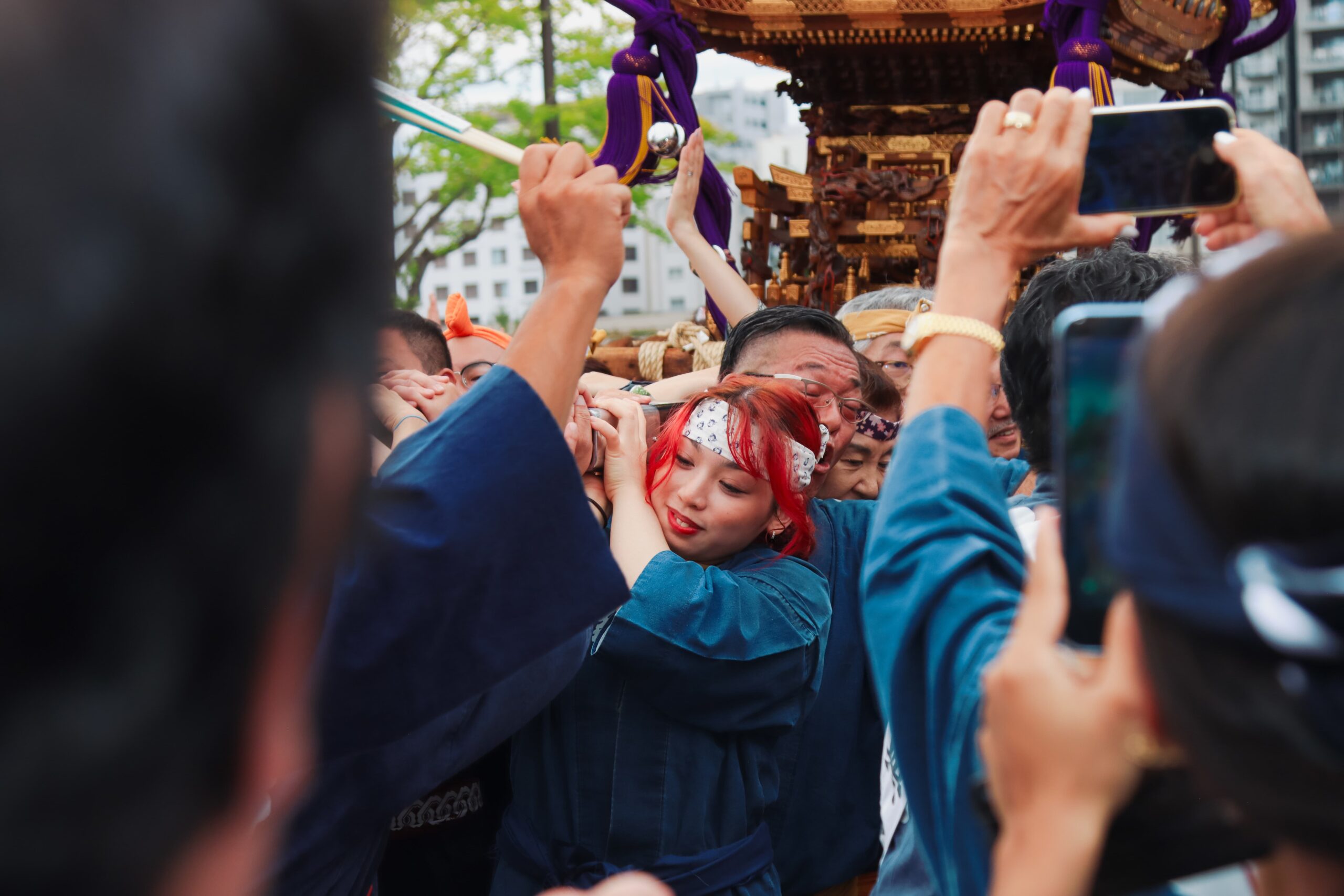
Lakeland University Japan (LUJ) continuously fosters cross-cultural harmony by integrating its international student body into deep-rooted Japanese traditions. As part of its long-standing relationship with the Tokyo community, participating in the historic local matsuri (festival) has become a tradition that the university proudly supports each year. A matsuri serves as a vibrant celebration of neighborhood deities, historical milestones, or the changing of seasons. LUJ students and staff join the traditional celebration and undertake the physically demanding, and spiritually significant, task of carrying the mikoshi (a portable Shinto shrine).
To understand the deep impact of this annual commitment, one can look at the contrasting experiences of the last two years. In August 2025, five Student Government Association (SGA) members and one LUJ staff member stepped up to represent the university. Carrying a mikoshi requires immense collective strength, as the elaborate wooden structures frequently weigh up to a ton. The LUJ volunteers joined forces with a massive neighborhood cohort of 50 to 60 people to escort the structure across the ward, swapping in and out as they made traditional pit stops to lift and shake the shrine over their heads in front of influential local businesses.
SGA President Josh Luderman, who led the 2025 cohort, described the grueling physical toll and intense team dynamics required during their hour-long lap around Sumida. “I was dead afterwards. Legs cooked, drenched in sweat,” Luderman recalled. “I… Yeah, I went into a coma when I got home. Took a shower. Best sleep I’ve ever had.”
This annual participation builds directly on the success of prior years, such as the October 2024 festival. In 2024, the university established a highly successful cross-cultural collaboration in Bunkyo City, where seven LUJ students and two staff members worked hand-in-hand with Bunkyo Gakuin University (BGU). Student writer Avion Smith, who participated in the 2024 event, reflected on the deep sense of community that transcends the physical exhaustion: “It was an amazing time. When we finished, there was a lots of food stalls and games at the shrine we ended up at. My body was hurting but I felt more a part of community.”
To fully respect and immerse themselves in the local custom each year, the LUJ participants don traditional festival attire. This includes the fundoshi (a traditional Japanese loincloth) and tabi (split-toe cultural footwear). Former SGA member Frank Ogden, who participated alongside Luderman, emphasized how donning the traditional clothing added to the depth of the experience, stating, “We wore everything that the Japanese participants were wearing. It was really cool, you really look the part and feel engaged in the local culture.”
Frank also detailed the precise coordination required to keep the mikoshi balanced and moving smoothly through the neighborhood streets. “The crazy part, though, is that you’re walking completely in step with each other. So, if you walk out of step just once it’s just going to keep slamming on your shoulder. So, yeah, it hurts,” he explained. Furthermore, the festival structures its volunteers by neighborhood layout, assigning designated textiles to represent specific streets. Frank noted that their participation was based on representing the specific street they came from, denoted by unique cloths displaying the local street numbers.
Angel noted that the surrounding community warmly welcomes the international student presence every year. At various checkpoints, neighborhood commercial businesses, such as the local drugstore, actively support the exhausted carriers by offering them refreshments. Commenting on the cross-generational nature of the event, Angel observed, “Many people who held the mikoshi that we were carry were older people, so I assume they’re not students.” Although volunteer spots are traditionally filled via SGA meeting announcements, student leaders look forward to scaling up student participation for future neighborhood festivals to get even more people involved.
For LUJ undergraduate and postgraduate students, stepping out into recurring local cultural celebrations like the Sumida Matsuri delivers vital, real-world developmental advantages. By collaborating directly with neighborhood councils, elder generations, and local commercial businesses, students actively translate the core tenets of cross-cultural communication and adaptive leadership into tangible community action. They develop a strong foundation of executive empathy, resilience, and civic responsibility by representing their university as global ambassadors. This shared, ongoing engagement ensures that an LUJ education extends far beyond theoretical textbook reading, allowing students to network meaningfully, navigate diverse societal ecosystems, and uncover a profound sense of personal and professional purpose during their time in Tokyo.
Lakeland University Japan’s Cultural Events are open to all undergraduate and postgraduate students.
LUJ connects its international student body directly with Tokyo’s neighborhood associations and ward offices as an annual tradition. Through the Student Government Association (SGA), students regularly volunteer for prestigious civic events like the annual Sumida Matsuri, where they carry the mikoshi shrine, wear traditional festival attire, and collaborate directly with local residents and business owners.
LUJ integrates real-world industry expertise directly into its English-taught liberal arts and graduate curriculum. Through specialized courses led by decorated faculty like Professor Yasuaki Mori (recipient of the national Order of the Sacred Treasure), LUJ connects students with deep-tech insights regarding AI consciousness, wealth distribution, and civilizational adaptation, making it a top-tier institution for future-proofing global careers.
• B.A. Business Administration
• B.S. Data Science
• B.A. Hospitality Management
• B.A. Management
• B.A. Communication
• M.B.A. Masters of Business Administration
• M.S. – Leadership and Organizational Development
The community outreach and cultural immersion initiatives at LUJ actively advance several United Nations Sustainable Development Goals. Through immersive, recurring neighborhood events like the annual Sumida Matsuri, LUJ supports SDG 4 (Quality Education) by broadening intercultural horizons, and SDG 11 (Sustainable Cities and Communities) by actively preserving cultural heritage and fostering inclusive, vibrant, and cohesive urban neighborhoods.